Psychological Safety Relating to Organizational Performance and Leadership Enables Focus on What Matters Rather Than Organizational Distortion Caused by Disruptive Behaviors.
The profitability and longevity of a company are the primary focus of the company’s stakeholders. Areas that can be focused on to ensure these goals remain a priority include:
- Reduction of Expenses
- Driving Innovation with Speed to Market
- Creation of Successful Strategies Without Fear of Breaking Down Antiquated Norms
- Increasing Productivity With Breakthrough Insight
- Improving Internal and External Communication Including Customer Service that Resonates With the Audience
- Utilizing Relevant Technological Innovation Rather Than the Latest Technological Trends
- Understanding the Competition Market Dynamics: Competition, Customers Now and in the Future to Achieve Business Objectives
- Regulatory Acuity
The stakeholders that are focused on the success of these objectives include both internal and external partners. Shareholders, owners, employees, wholesalers, suppliers, customers, and the government all are stakeholders with something to gain or lose as the company evolves. In each of the above-listed goals, each component has an objective that helps in providing a product or service to an end client/customer. The strategies of Needs Based Selling and Consultative Selling have been well-used tools to develop new businesses and can be leveraged by leadership to gain by-in and understand obstacles.
Needs-based selling puts attention on the individual customer/stakeholder and focuses on discovering their needs through active listening and specific questions designed to extract information that is used to construct a plan that meets these particular needs of the business and customer/stakeholder.
Consultative selling flows from discovering the needs and developing a personal relationship and trust between the client and company representative that encourages open and honest dialogue.
If we take the strategies of Needs Based Selling along with Consultative Selling and focus them away from the end client and towards the company’s stakeholders with a Psychological Safe Environment, a new dynamic is created that affects each of the goals for profitability and success.
These techniques can be effective with all stakeholders and are most transformative for the company and provide a platform of collaboration when leveraged by the employee and management teams.
The question then becomes, how does one create a focus on the needs of these teams and create the trust that leads to honest dialogue and discovery? The answer is the introduction and sustainment of Psychological Safety into the workplace, that embraces learning.
Looking at the workplace we find competitive dynamics, a spectrum of people with varying needs and motivations, as well as varied degrees of power and autonomy. Within this complex arena, the goal is to discover and meet the needs of the many. We all have seen the disruptive-defensive – power acquisition noticing behaviors, such as the “Screaming Monkey in the Cage or Fire Starter” or the “Niagara Falls” well known for a stakeholder who carries frame of reference narratives-triggers that filters their ability to achieve authentic listing and instead the stakeholder engages in pre-emptive blaming attacks to disenfranchise a collaborating organization, a change initiative, or the change agent.
Reference of the “Niagara Falls Skit”
These behaviors exist in the organization because the organization rewards the behaviors, and therein lies the challenge, which often time needs an outside consultant as a business partner.
A good place of reference is Maslow’s hierarchy of needs. This is a familiar motivational theory in psychology. It is comprised of a five-tier model of human needs. The lower needs at the bottom of the pyramid must be satisfied before individuals can attend to their higher needs.
Looking at the workplace we find competitive dynamics, a spectrum of people with varying needs and motivations, as well as varied degrees of power and autonomy. Within this complex arena, the goal is to discover and meet the needs of the many.
A good place of reference is Maslow’s hierarchy of needs. This is a motivational theory in psychology. It is comprised of a five-tier model of human needs. The lower needs at the bottom of the pyramid must be satisfied before individuals can attend to higher needs.
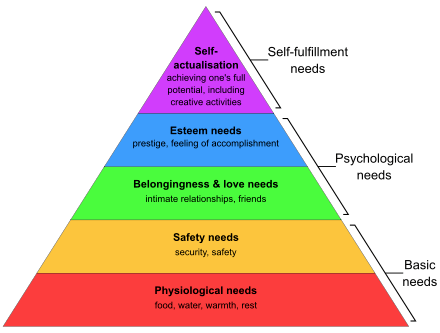
We can see that part of the basic needs is safety and security. As we move higher up the pyramid, relationships, self-esteem, and self-actualization become a priority.
The employee and leadership teams have the same needs. Psychological Safety when implemented in the workplace creates a dynamic that not only meets the needs of Maslov’s Hierarchy but creates an environment that stimulates a level of collaboration, learning, and creativity that supports the growth and success of the company.
Psychological Safety relating to Organization Performance Theories of Amy Edmonson, Harvard Business School Professor, and Author, is a belief that one will not be punished or humiliated for speaking up with ideas, questions, concerns, mistakes, or doing the right thing when it means pausing or slowing down to achieve the initiative safely or with regulatory acuity.
Psychological Safety provides a platform that promotes the performance needed to meet the goals of the organization.
“To understand why psychological safety promotes performance, we must reconsider the nature of so much of the work in today’s organizations. With routine, predictable, modular work on the decline, more and more of the tasks that people do require judgment, coping with uncertainty, suggesting new ideas, and coordinating and communicating with others. This means that voice is mission-critical. And so, for anything but the most independent or routine work, psychological safety is intimately tied to freeing people up to pursue excellence.” ― Amy C. Edmondson, The Fearless Organization: Creating Psychological Safety in the Workplace for Learning, Innovation, and Growth

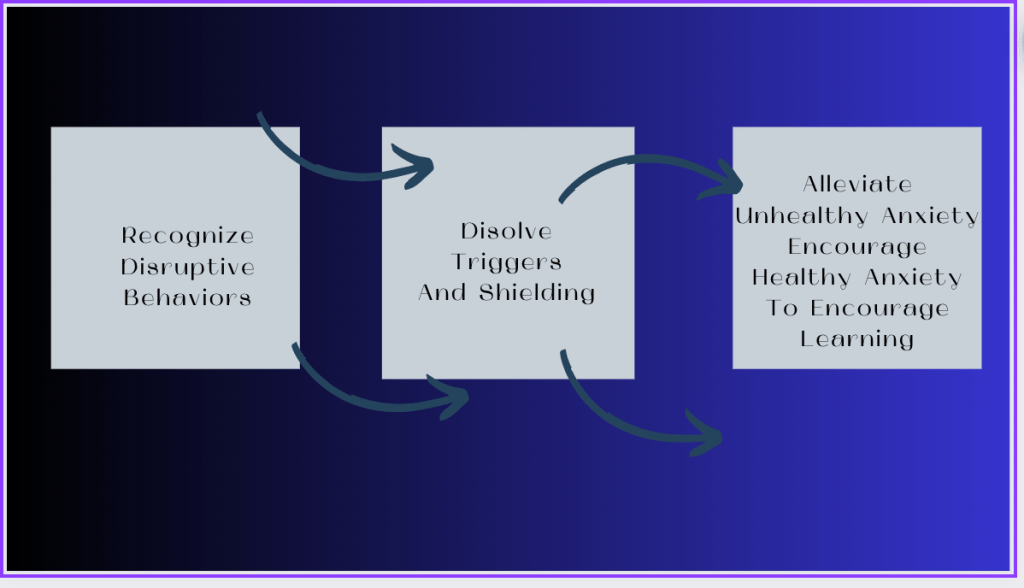
To determine the organization’s level of Psychological Safety, observe the team’s interactions and it helps to have an outside neutral team/consultant. To define through the appropriate observation, psychometric types of assessments, engagement with leadership and team members and create roadmaps:
What happens in team meetings? Does everyone share ideas?
Are disruptive behaviors present and rewarded? Are the meetings very quiet? Are people collaborating and building on each other’s ideas? Who contributes the most? Outside of meetings are your staff reporting their mistakes, asking for help, and being critical of others?
How does the team leverage emails? How approachable is the leadership team?
Creating a work environment that does not shut down creativity, comradery, and the ultimate success of the team, requires removing infighting, finger-pointing, scapegoating, gaslighting, and a myriad of behaviors that make people feel insecure, untrusting, feelings of unhealthy anxiety, and apathetic.
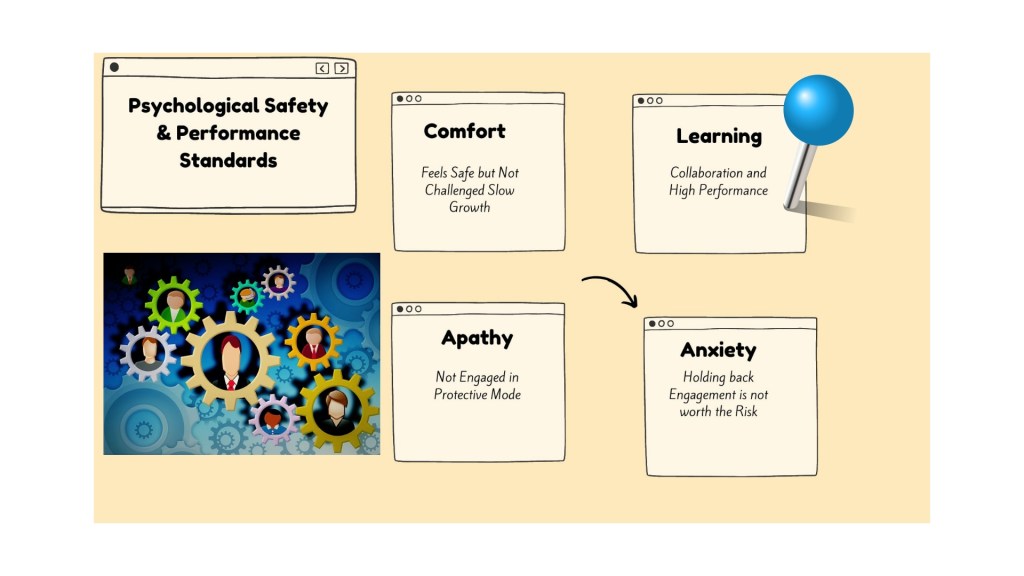
Psychological Safety helps to create conditions that foster high-performance teams. These teams own a respectful environment, working together and finding solutions.
Their leadership team can detect problems early as team members feel safe to express vulnerable feelings and acknowledge mistakes and areas where knowledge is lacking.
Organizational growth develops from the personal growth of the team, as acceptance of differing opinions leads to trust and collaborative efforts.
The introduction of Psychological Safety in the workplace takes us back to the principles of Needs Based Selling. Active Listening must be encouraged.
Active Listening includes seeing others’ perspectives without acting on our own triggers, trying to understand new concepts and ideas, giving room for differing thoughts, interpreting and repeating back ideas, offering feedback, asking questions to delve further into these ideas, and encouraging the speaker to share more.
Along with Active Listening, a mindset must be developed that is less judging. Kindness must replace sarcasm. Criticism should be constructive and feedback from others must be looked at as help to move each other towards improvement. To achieve this the leadership team must set an example. The leaders must encourage feedback, make inclusive decisions, and encourage everyone to ask questions and offer opinions. This requires being approachable so employees don’t feel intimidated. Celebrating differences, accepting the mistakes of others as an opportunity to grow, learning and succeeding together, and setting standards are ways to lead by example.
Role modeling is the behavior that grows a workplace where mistakes are expected and accepted, everyone’s opinions are respected, and problems are not blamed on any person, instead, everyone works to fix problems together and fighting is not acceptable.
Creating an environment where people are not interrupted when expressing themselves, and their opinions are not challenged as a personal attack or one-upmanship may seem very different from what your team is used to. These perceptions will change by establishing brainstorming sessions where no idea is considered too “out there”, and support and constructive feedback are expected.
This type of workplace places importance on engagement, motivation, learning development, and performance. It pushes people out of their comfort zones and takes time and commitment.
“Psychological safety is not at odds with having tough conversations – it is what allows us to have tough conversations.” Amy Edmondson on Twitter
The goal is to create a team of powerful collaborators that will work together, even in hard times to meet the goals of all the stakeholders and help the company to be profitable, stable, and a highly functioning and enjoyable place to work.
“The core idea is that our nervous systems have a Goldilocks zone of arousal. Too little, and you remain in the comfort zone, where boredom sets in. But too much, and you enter the ‘panic’ zone, which also stalls progress” and defaults to apathy:
References:
Source: PositivePsychology.com Toolkit – ‘Leaving The Comfort Zone’
https://positivepsychology.com/comfort-zone/
The Power of Yet: Not Yet:
 quantensprunggroup.com